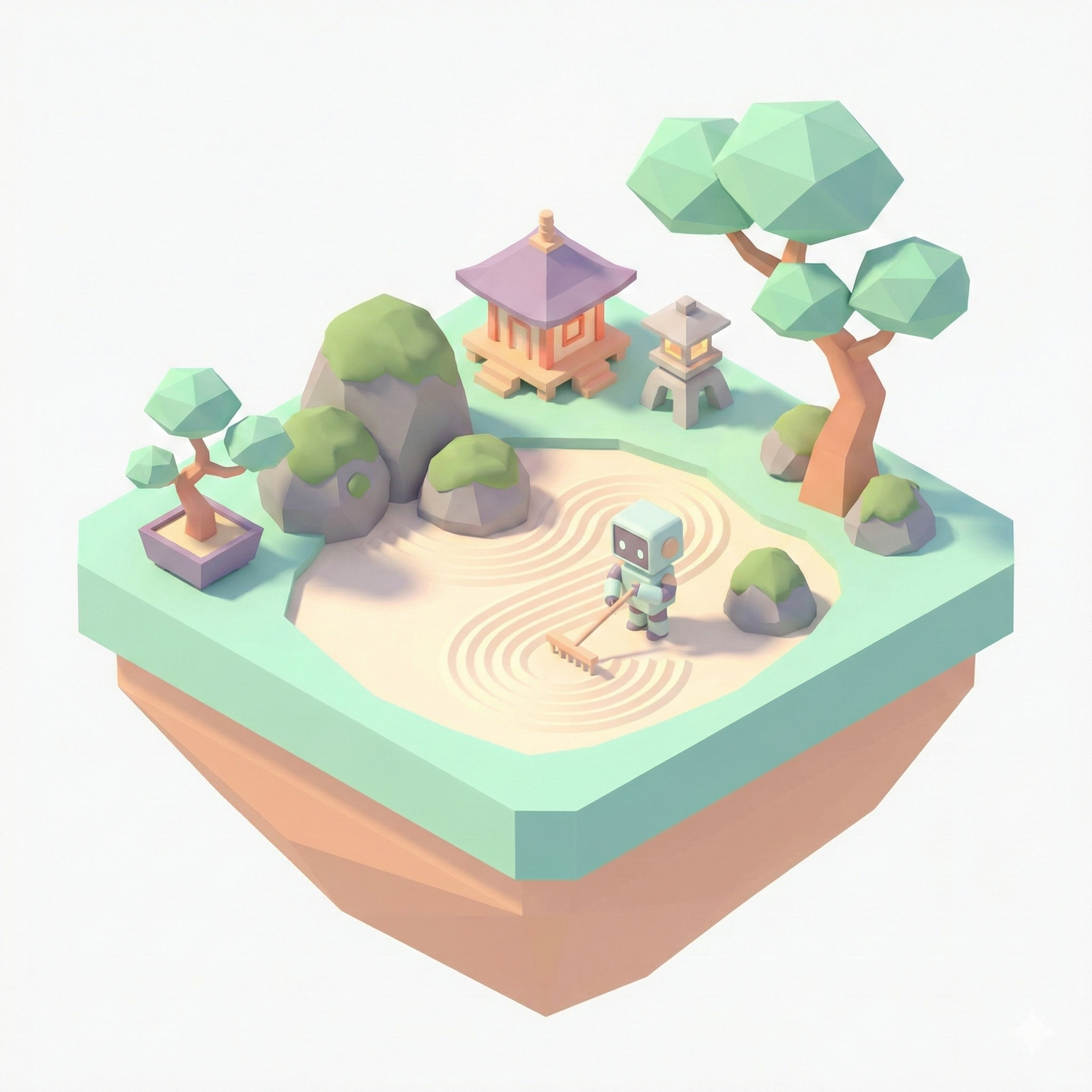
The GeoBots Vision
As a parent and a developer, I have a complicated relationship with screens.
We know that tablets and phones are incredibly powerful tools for learning. They can transport a child to the other side of the world in seconds, letting them hear languages they would never encounter in their living room.
But we also know the other side. The anxiety of handing over your unlocked phone. The sudden blast of noise from an aggressive ad. The dark patterns designed to hook a dopamine response rather than spark curiosity.
When I sat down to design GeoBots, I didn’t want to just “make a game.” I wanted to solve a specific problem in the mobile ecosystem: How do we create a digital space that feels as safe and creative as a physical playroom?
The answer lay in three concepts: The Walled Garden, Calm Technology, and Tactile Learning.
Here is a look “under the hood” at the design philosophy behind GeoBots.
1. The “Walled Garden” Concept️
In user experience (UX) design, a “Walled Garden” usually refers to a closed ecosystem (like Apple’s). But for children’s software, I interpret it differently.
For a child, a Walled Garden is a safe, enclosed play area. Inside the walls, they are free to run, touch, and explore without danger. They don’t need a parent hovering over their shoulder every second because the environment itself prevents them from wandering into traffic.
Most free mobile games are not walled gardens; they are busy intersections. They have “gates” that lead to the mobile stores, to advertisers, or to social media tracking.
GeoBots is designed as a true Walled Garden:
- No Outbound Links: Once the game starts, there are no buttons that take the child out of the app.
- Zero Ads Strategy: We didn’t just remove ads; we removed the infrastructure for ads. There is no code in the game that calls to an ad server. This means no tracking, no data usage for videos, and no risk of inappropriate content.
2. “Calm Tech” vs. Hyper-Stimulation
If you look at the top charts for kids’ games, you will see a trend: Hyper-stimulation. Flashing lights, constant reward loops, frantic music, and time limits.
This mimics the design of slot machines, not educational toys.
With GeoBots, we adopted the philosophy of “Calm Technology.” We asked ourselves: What if a video game felt more like a picture book?
- No Timers: Learning doesn’t happen when you are rushing. In GeoBots, if a child wants to stare at the Japanese pagoda for five minutes or watch the cherry blossoms fall, they can.
- Ambient Audio: Instead of frantic loops, we use atmospheric soundscapes. The background music creates a focus state, not a frenzy state.
- Failure-Free Gameplay: Nori-Maki (our sushi character) needs help, but you can’t “lose” the game. You can’t die. You can’t run out of lives. This lowers cortisol levels and keeps the child’s brain open to absorbing new information—like the 8 languages we included.
3. Tactile Learning in a 3D World
Children learn with their hands. They push, pull, drop, and spin things to see what happens. This is the basis of the Montessori method.
Translating this to a touch screen is difficult. A screen is flat glass; it has no texture. So, how do we make it feel “real”?
We used the Godot 4 Engine to build a physics-based interaction system.
- Weighty Buttons: When you tap a button in GeoBots, it doesn’t just flash. It sinks down, clicks, and springs back.
- Kinetic Response: If a GeoBot bumps into a crate, the crate slides. If they step on a wooden plank, it creaks.
We spent weeks tweaking these micro-interactions. Why? Because when the digital world behaves like the physical world, it becomes intuitive. A 3-year-old doesn’t need a tutorial to know that a lever needs to be pulled. They just know.
Why We Chose Open Source (Godot 4)
Finally, a note on the technology. We built this entire experience using Godot 4, an open-source game engine.
Why does this matter to a parent? Because open-source software is built on transparency. We aren’t beholden to massive proprietary tech giants. Using Godot allows us to optimize the game for older devices—so you can give your child that old tablet you have in the drawer, and GeoBots will still run at a smooth 60 frames per second.
Conclusion
The result of these decisions is the debut adventure in our series, GeoBots: Japan for Kids.
It is not a game designed to keep your child addicted for hours. It is designed to be played for 15 or 20 minutes of quality, focused exploration. It is a digital toy that respects your child’s intelligence and your peace of mind.
We are launching this Thursday on Google Play. We can’t wait to welcome you into the garden.